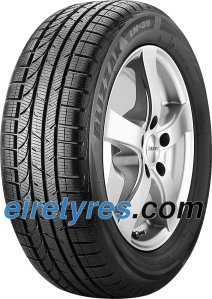
The Blizzak LM-35 targets high-powered cars up to V speed rating. It offers motorists a class-leading driving experience with secure winter performance and motorway handling at high speed in wet and dry.
Precision Response: Bridgestone’s unique Blizzak lamellen technology offers superb stability and balanced performance on wet and dry surfaces, on snow and ice, ensuring you meet the challenges of winter head on. The pattern design features 4 wide grooves for fast drainage from the contact patch and effective braking and acceleration, 3D-shaped block edges to increase resistance to hydroplaning, and a longitudinal cast groove on the shoulder blocks for maximizing cornering stability.
New washboard sipe technology maintains block stability for optimal handling performance
3-Dimensional block shape design for precision control and resistance to aquaplaning
Stiff shoulder blocks for superb dry and wet weather handling
Advanced polymer top compound ensuring excellent grip in all conditions
Bridgestone has also made the new Blizzak LM-35 more environment-friendly and economical, compared to the Blizzak LM-25 it replaces. By reducing rolling resistance by up to 16% through weight loss resulting from the optimization of the carcass shape and belt package, fuel consumption has been cut by up to 2.5% and CO2 emissions reduced by up to 4.5 g/km. The LM-35 also reduces pass-by noise by more than 1dB and in-car noise by 2dB.
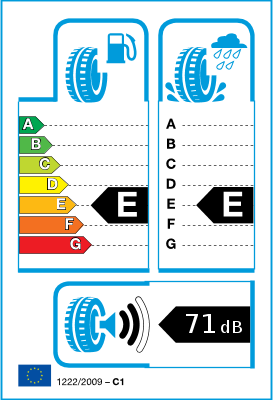
The Tire Labeling Ordinance specifies the information requirements on fuel efficiency, wet grip and external rolling noise from tires. In addition, reference is made to the winter properties of the product.
The EU 1222/2009 regulation that has been in force since November 1st, 2012 has been revised and will be replaced by regulation EU 2020/740 from May 1st, 2021; From this point on, new requirements apply. The rating classes for fuel efficiency, wet grip and exterior noise have been changed and the layout of the EU label has been adjusted. The manufacturer's product data sheets stored in the EU database can be downloaded via a QR code integrated into the label. Information on snow grip and ice grip is also newly included for tires that meet these criteria.
The following tires are exempt from the regulation: - tires that are designed exclusively for installation on vehicles that were first registered before October 1, 1990 - retreaded tires (until a corresponding extension of EU VO 2020/740 has taken place) - professional off - Road tires - Racing tires - Tires with additional devices to improve traction, eg studded tires - T-type emergency tires - Tires with a permissible speed below 80 km/h - Tires for rims with a nominal diameter ≤ 254 mm or ≥ 635 mm
The criteria and evaluation classes at a glance
fuel efficiency
The fuel consumption depends on the rolling resistance of the tyres, the vehicle itself, the driving conditions and the driving style of the driver. The measured rolling resistance (rolling resistance coefficient) of the tire is divided into classes A (highest efficiency) to E (lowest efficiency).
If a vehicle is completely equipped with class A tires, a consumption reduction of up to 7.5%* is possible compared to class E tyres. In the case of commercial vehicles, it can even be higher. (Source: European Commission Impact Assessment * when measured according to the test methods set out in Regulation (EU) 2020/740)
Please note: Fuel consumption depends to a large extent on your own driving style and can be significantly reduced by driving in an environmentally friendly manner. Tire pressure should be checked regularly to improve fuel efficiency.
wet grip
Wet grip is divided into classes A (shortest braking distance) - E (longest braking distance).
If a car is equipped with class A tires, compared to class E tires, a braking distance of up to 18 m can be reduced when braking from 80 km/h (on a road surface with average grip).* *Source: wdk Economic Association of the German Rubber Industry eV
Please note: Traffic safety depends to a large extent on your own driving style. The stopping distances must always be observed. Tire pressure should be checked regularly to improve wet grip.
External rolling noise
The noise emitted by a tire affects the overall volume of the vehicle and affects not only your own driving comfort, but also the noise pollution of the environment. In the EU tire label, the external rolling noise is divided into 3 classes from A (lowest rolling noise) - C (highest rolling noise), measured in decibels (dB) and compared with the European noise emission limit values for external tire rolling noise.
A The pictogram with the classification "A" indicates that the tire's external rolling noise is more than 3 dB below the EU limit value in force until 2016. B The "B" classification means that the tyre's external rolling noise is up to 3 dB below or equal to the EU limit value in force until 2016. C The classification "C" indicates that the specified limit value is exceeded.














 %service-partner-advantages-list%