






%service-partner-advantages-list%
Semperit Van-Grip 2 185 R14C 102/100Q 8PR
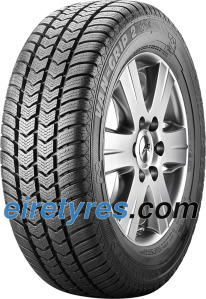
Semperit
Van-Grip 2
185 R14C 102/100Q 8PR
Semperit - Quality tyres in the middle price segment. A brand of Continental.
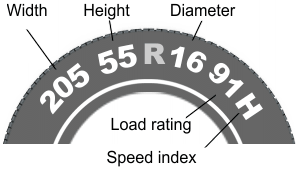
2. Ratio of tire height to tire width in%
3. Tire design: 'R' = radial tires (widely used), 'D' or '-' = diagonal tires (rare)
4. Required rim diameter for this tire in inches
5. Key figure for tire load capacity
6. Key figure for the permissible maximum speed (speed index)
7. Motorcycle tire identification, tires only approved for motorcycles
8. DOT labeling
9. Date of manufacture of the tire (week of production / year of production)
PR is an abbreviation of "ply rating". This label originally indicated the number of layers of cotton fishing line in the shell. A large number of bearings means a higher load capacity. When stronger materials were introduced for bearings, this term was removed from the actual number of bearings. Currently, a tire with 8 PR can only have four nylon linear bearings. Today, the stability of a controlled tire is expressed in terms of load capacity and speed capacity, and not in terms of the ply rating.
- Manufacturer description
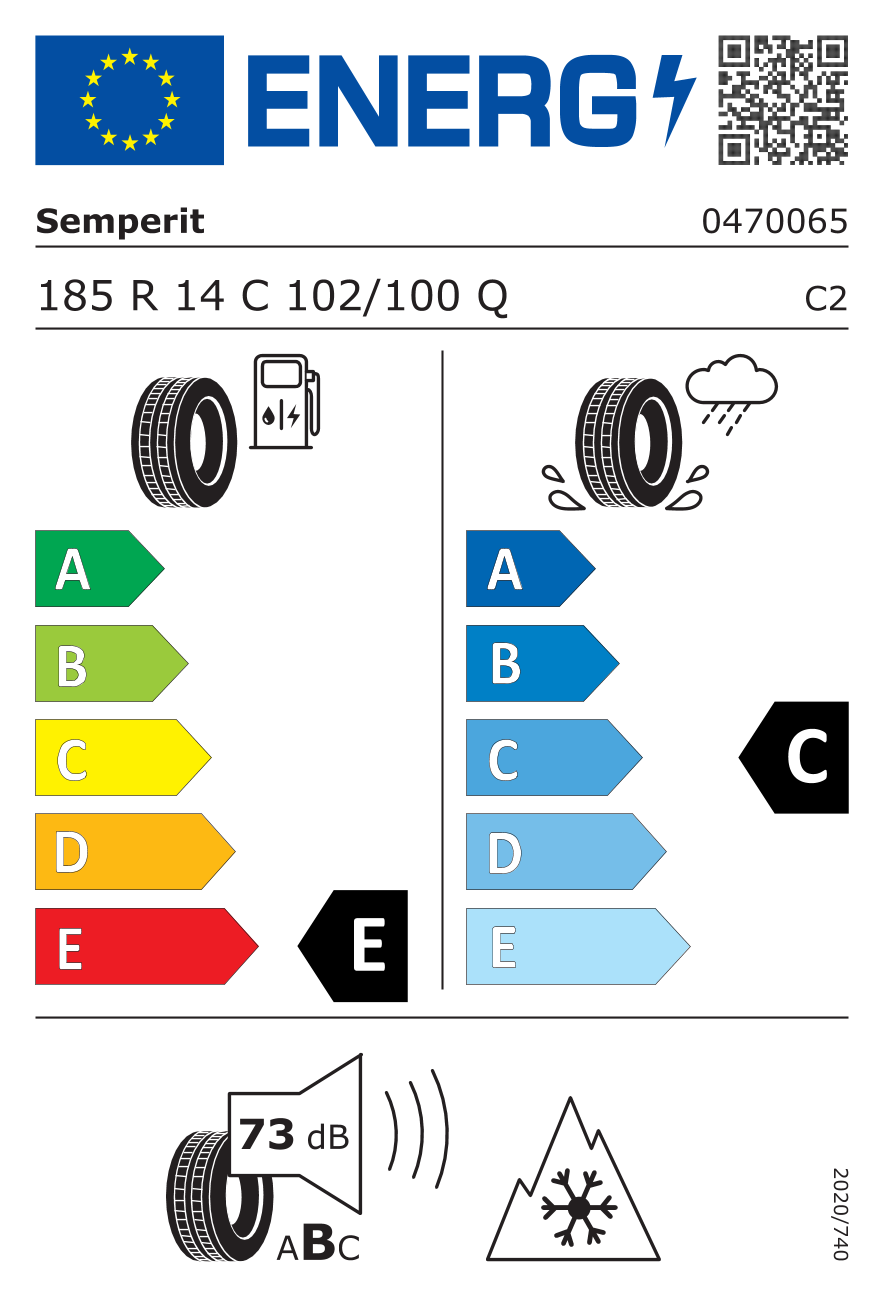
- Tire Label
- General Product Safety (GPSR)
Van-Grip 2 - The resilient. Defy winter.
Resilient winter expert with only one goal: to bring every load through snow and ice to your destination. A worthy addition to the alpine proven Semperit winter tire range. For MPVs, minibuses and light vans. Brings every load through snow and ice to your destination.
- The Semperit quality, provides maximum safety, even under tough conditions
- Improved snow performance
- Fits perfectly for example to Nissan NV400, Renault Master and Opel Movano
Technical Details:
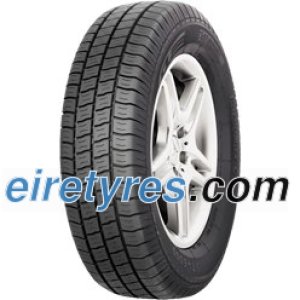
The new directional tread pattern promises improved performance on snow-covered and wet surfaces, even under heavy load.
- High number of tread edges: improved snow performance
- Directional tread pattern with wide grooves: good aquaplaning performance.
- Improved rubber compound: reduced rolling resistance
Improved snow performance
- High number of tread edges for improved interlocking on snow-covered roads
- Your advantage: significantly improved grip and shorter breaking distances, even under heavy load
Good aquaplaning performance
- Directional tread pattern with wide grooves for improved water displacement
- Your advantage: safe driving on wet and slushy roads as a result of reduced aquaplaning
Reduced rolling resistance
- Improved rubber compound for excellent grip and reduced rolling resistance.
- Your advantage: lower fuel consumption and therefore very efficient
Sidewall protection
- Robust designed scuff rib with additional layer of rubber on the sidewall for imroved protection from kerbstone abrasion
- Your advantage: Very economical due to prolonged tire life
EU Tyre Label and Efficiency Classes
The Tire Labeling Ordinance specifies the information requirements on fuel efficiency, wet grip and external rolling noise from tires. In addition, reference is made to the winter properties of the product.
The EU 1222/2009 regulation that has been in force since November 1st, 2012 has been revised and will be replaced by regulation EU 2020/740 from May 1st, 2021; From this point on, new requirements apply. The rating classes for fuel efficiency, wet grip and exterior noise have been changed and the layout of the EU label has been adjusted. The manufacturer's product data sheets stored in the EU database can be downloaded via a QR code integrated into the label. Information on snow grip and ice grip is also newly included for tires that meet these criteria.
The following tires are exempt from the regulation: - tires that are designed exclusively for installation on vehicles that were first registered before October 1, 1990 - retreaded tires (until a corresponding extension of EU VO 2020/740 has taken place) - professional off - Road tires - Racing tires - Tires with additional devices to improve traction, eg studded tires - T-type emergency tires - Tires with a permissible speed below 80 km/h - Tires for rims with a nominal diameter ≤ 254 mm or ≥ 635 mm
The criteria and evaluation classes at a glance
fuel efficiency
The fuel consumption depends on the rolling resistance of the tyres, the vehicle itself, the driving conditions and the driving style of the driver. The measured rolling resistance (rolling resistance coefficient) of the tire is divided into classes A (highest efficiency) to E (lowest efficiency).
If a vehicle is completely equipped with class A tires, a consumption reduction of up to 7.5%* is possible compared to class E tyres. In the case of commercial vehicles, it can even be higher.
(Source: European Commission Impact Assessment
* when measured according to the test methods set out in Regulation (EU) 2020/740)
Please note:
Fuel consumption depends to a large extent on your own driving style and can be significantly reduced by driving in an environmentally friendly manner. Tire pressure should be checked regularly to improve fuel efficiency.
wet grip
Wet grip is divided into classes A (shortest braking distance) - E (longest braking distance).
If a car is equipped with class A tires, compared to class E tires, a braking distance of up to 18 m can be reduced when braking from 80 km/h (on a road surface with average grip).*
*Source: wdk Economic Association of the German Rubber Industry eV
Please note:
Traffic safety depends to a large extent on your own driving style. The stopping distances must always be observed. Tire pressure should be checked regularly to improve wet grip.
External rolling noise
The noise emitted by a tire affects the overall volume of the vehicle and affects not only your own driving comfort, but also the noise pollution of the environment. In the EU tire label, the external rolling noise is divided into 3 classes from A (lowest rolling noise) - C (highest rolling noise), measured in decibels (dB) and compared with the European noise emission limit values for external tire rolling noise.
A
The pictogram with the classification "A" indicates that the tire's external rolling noise is more than 3 dB below the EU limit value in force until 2016.
B
The "B" classification means that the tyre's external rolling noise is up to 3 dB below or equal to the EU limit value in force until 2016.
C
The classification "C" indicates that the specified limit value is exceeded.
Continental Reifen Deutschland GmbH
Continental-Plaza 1, 30175, Hannover, Germany