






%service-partner-advantages-list%
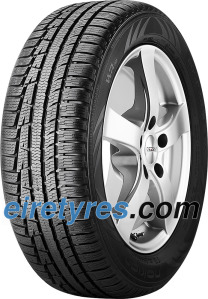
Nokian WR A3 RunFlat 245/45 R18 100V XL , runflat
Nokian
WR A3 RunFlat
245/45 R18 100V XL , runflat
- Manufacturer description
- Tire Label
- General Product Safety (GPSR)
Nokian WR A3 RunFlat
- Absolute grip and excellent handling in all winter conditions
- Stable and easy to control even at high speeds
- Rolls lightly, saving the environment and fuel
The Nokian WR A3 is optimised for efficient cars with a special emphasis placed on the tyre's precise and sensitive driving at higher speeds. This environmentally friendly premium product feature nanotechnology, canola oil and the solid winter expertise of Nokian Tyres, which guarantee reliable functionality in the typically varying winter conditions of Central Europe.
Nanobase for optimal stability
The sporty Nokian WR A3 has an asymmetrical inside-outside tread pattern that enables reliable grip without compromising high-speed driving properties. The inner shoulder design enhances the removal of water and slush. The Nanobase structure enabled by nanotechnology improves the tyre's steering properties and control when driving in corners, changing lanes and dodging. The tyre has exemplary control properties in extreme situations on both slippery surfaces and roads offering a firm grip. The tread rubber compound, the Cryogenic Canola Compound, is a novel combination of natural rubber, silica and canola oil that optimises winter grip, wet grip and wear resistance in varying temperatures.
The golfball-like Silent Groove Design for a more pleasant response and higher mileage
The semi-round cavities on the sides of the longitudinal ribs, resembling a golf ball pattern, cool the Nokian WR A3 by minimizing the heat emission and make it more durable and safe even at high speeds. This innovation, called Silent Groove Design, also reduces drag and ensures better mileage thanks to lower fuel consumption. Moreover, it successfully minimises the inside and pass-by noise of the vehicle. The Silent Sidewall Technology increases driving comfort. Distinct zone in the sidewall filters the noise and vibration emitted from the road surface through the tyre tread and relays it to the bead area to reduce the noise heard inside the vehicle.
Winter Safety Indicator for added safety and comfort
Flawless winter driving is possible only if the tyres are in good condition. Nokian WR A3 is equipped with the comfort-adding Driving Safety Indicator (DSI) with the unique snowflake symbol, the Winter Safety Indicator. Patented by Nokian Tyres, this standard element located on the tyre's tread blocks indicates the depth of the main grooves in millimetres. The snowflake symbol remains visible until the groove depth is four millimetres. The tyre sidewalls have the familiar info area for tyre pressure recommendations. The right tyre pressure makes steering more accurate, reduces tyre damage and lowers fuel costs.
Flat Run Tire Technology
Nokian FRT (Flat Run Technology) is a special construction for car tires, which allows driving on them even without pressure in the event of a flat tire. Some car manufacturers use these kinds of tires on their cars, but generally only to ensure safe driving to the dealership after accidental damage. Nokian FRT tires have stronger construction than normal tires. The sidewalls have a special component to provide extra stiffness to the sidewalls when driving without pressure. Nokian FRT tires have an exceptionally strong structure. At normal pressure, FRT tires operate like normal tires.
Driving on Nokian Flat Run tires
With Nokian’s FRT tires, you can drive approximately 30 miles (50 kilometres) with a flat, if the car is fully loaded. If the car is only carrying the driver, the transition drive can be up to 90 miles (150 kilometres). Nokian Tyres recommends a maximum speed of 50 miles per hour (80 km/h). Under very slippery conditions, the speed should be kept at approximately 30 mph (50 km/h). For safety reasons, run flat tires can only be mounted on cars equipped with air pressure monitoring that is integrated into the IT system (or some other system that warns of changes in tire pressure changes) and a driving stability management system (ESP).
Repairing Flat Run tires manufactured by Nokian Tyres
Tires with this structure can be repaired in the tread area (such as in the case of nail punctures etc.) using adequate tubeless repair, if you are absolutely sure that the tire has not been driven when clearly below the recommended pressure or when flat. You need to inspect the tire closely from the inside and out to observe any traces of driving below the recommended pressure. Driving for even a short distance when the tire is flat may cause a rupture between the sidewall component and frame that cannot be visually observed. With regard to the safety aspects, we do not recommend that suspect tires be repaired at all; it is better to replace them. This repair procedure covers tires up to speed category H. We do not recommend that tires in the higher speed categories (V / W / Y) be repaired at all.
Run flat/Flat Run property
You can drive about 50 kilometres on an empty tyre if the car is fully loaded. If the car is only carrying the driver, the transition drive can be up to 150 kilometres. Nokian Tyres recommends a maximum speed of 80 kilometres per hour. In very slippery conditions the speed should be kept down to about 50 km/h. For safety reasons, run flat tyres can only be mounted on cars with air pressure monitoring that is integrated into the IT system or some other system that warns of tyre pressure changes, and a driving stability management system (ESP).
EU Tyre Label and Efficiency Classes
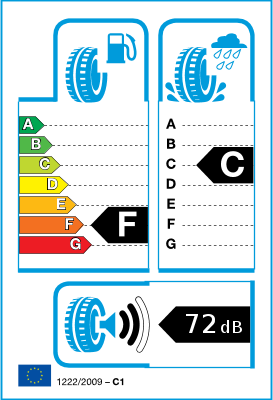
The Tire Labeling Ordinance specifies the information requirements on fuel efficiency, wet grip and external rolling noise from tires. In addition, reference is made to the winter properties of the product.
The EU 1222/2009 regulation that has been in force since November 1st, 2012 has been revised and will be replaced by regulation EU 2020/740 from May 1st, 2021; From this point on, new requirements apply. The rating classes for fuel efficiency, wet grip and exterior noise have been changed and the layout of the EU label has been adjusted. The manufacturer's product data sheets stored in the EU database can be downloaded via a QR code integrated into the label. Information on snow grip and ice grip is also newly included for tires that meet these criteria.
The following tires are exempt from the regulation: - tires that are designed exclusively for installation on vehicles that were first registered before October 1, 1990 - retreaded tires (until a corresponding extension of EU VO 2020/740 has taken place) - professional off - Road tires - Racing tires - Tires with additional devices to improve traction, eg studded tires - T-type emergency tires - Tires with a permissible speed below 80 km/h - Tires for rims with a nominal diameter ≤ 254 mm or ≥ 635 mm
The criteria and evaluation classes at a glance
fuel efficiency
The fuel consumption depends on the rolling resistance of the tyres, the vehicle itself, the driving conditions and the driving style of the driver. The measured rolling resistance (rolling resistance coefficient) of the tire is divided into classes A (highest efficiency) to E (lowest efficiency).
If a vehicle is completely equipped with class A tires, a consumption reduction of up to 7.5%* is possible compared to class E tyres. In the case of commercial vehicles, it can even be higher.
(Source: European Commission Impact Assessment
* when measured according to the test methods set out in Regulation (EU) 2020/740)
Please note:
Fuel consumption depends to a large extent on your own driving style and can be significantly reduced by driving in an environmentally friendly manner. Tire pressure should be checked regularly to improve fuel efficiency.
wet grip
Wet grip is divided into classes A (shortest braking distance) - E (longest braking distance).
If a car is equipped with class A tires, compared to class E tires, a braking distance of up to 18 m can be reduced when braking from 80 km/h (on a road surface with average grip).*
*Source: wdk Economic Association of the German Rubber Industry eV
Please note:
Traffic safety depends to a large extent on your own driving style. The stopping distances must always be observed. Tire pressure should be checked regularly to improve wet grip.
External rolling noise
The noise emitted by a tire affects the overall volume of the vehicle and affects not only your own driving comfort, but also the noise pollution of the environment. In the EU tire label, the external rolling noise is divided into 3 classes from A (lowest rolling noise) - C (highest rolling noise), measured in decibels (dB) and compared with the European noise emission limit values for external tire rolling noise.
A
The pictogram with the classification "A" indicates that the tire's external rolling noise is more than 3 dB below the EU limit value in force until 2016.
B
The "B" classification means that the tyre's external rolling noise is up to 3 dB below or equal to the EU limit value in force until 2016.
C
The classification "C" indicates that the specified limit value is exceeded.
Nokian Tyres plc
Pirkkalaistie 7, P.O.Box 20, FI-37101, Nokia, Finnland