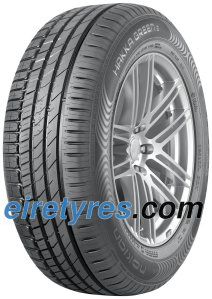
The new Nokian Hakka Green 2 – Naturally safe
- Uncompromising grip on wet roads
- Comfortable, balanced handling
- Very low fuel consumption
- Durable safety – strong structure and excellent wear resistance
The Nokian Hakka Green 2 rolls lightly and offers excellent durability
The lightly rolling first-born of the Nokian Hakka summer tyre family, designed for the Northern roads, has been completely renewed.
Durable safety – new Nokian Hakka Green Hybrid rubber compound
The Nokian Hakka Green Hybrid rubber compound is at the heart of the reliable safety features, improved wear resistance and green nature of the Nokian Hakka Green 2, the supreme ruler of the varying Northern summer. The silica particles in the tread compound form a tight mesh that adapts to the conditions, improving wet grip and driving comfort. The pine and canola oils added to the rubber compound lower rolling resistance, thereby allowing the tyre to roll lighter. The small particles of the carbon black, which are also used in forestry and mining tyres, put the final touches on the strong and durable, chameleon-like rubber compound.
Sturdy structure improves wear resistance
The sturdy steel belt structure of this new Nokian Hakka product consists of individual brass-coated steel wires. A single wire consists of two filaments that have been wrapped together. The diameter of a single filament is only 0.25 mm, but it has enough pulling strength to tow a passenger car. The strength of the steel wire has increased by over 15% compared to its predecessor, the test-winning Nokian Hakka Green.
The even more flexible, yet stronger, steel belt structure offers numerous benefits when combined with the Nokian Hakka Green Hybrid rubber compound and a modern asymmetrical tread pattern. The stable handling makes lane changes easy and controlled. The lighter, eco-friendlier rolling can be seen in the reduced fuel bill. Improved cut and puncture protection ensures additional kilometres. According to taxi tests performed in the Nordic countries, the wear resistance of the new Hakka Green 2 is up to 15% higher than its predecessor.
Avoid aquaplaning – Blade Grooves and Coanda Technology
In the Nordic Summer Tyre Survey, safe and good handling under all conditions was the most valued tyre characteristic among drivers. Good grip and driving comfort were also at the top of the list.
The wet grip properties of this stylish new product were fine-tuned by using a new rubber compound. The tread pattern is also more open than before; this, together with the polished grooves, effectively prevents the dangers of rainy weather. Aggressive Blade Grooves that widen towards the inner shoulder cut through the massive ribs in the centre area, effectively storing water and guiding it towards the longitudinal grooves.
The Nokian Tyres Coanda Technology accelerates the removal of water from the longitudinal groove and effectively prevents aquaplaning. The curved, ramp-like design of the tread blocks on the inner shoulder guides and accelerates the flow of water from the longitudinal groove into the transverse groove. The Coanda effect refers to the tendency of flow to turn towards a nearby surface. The Coanda effect is also utilised to improve the aerodynamics of aeroplane wings and Formula 1 cars.
Nokian Tyres Coanda Technology is a new technical innovation from the world’s northernmost tyre manufacturer. It guides and accelerates the removal of water from between the tyre and the road. The innovation effectively prevents aquaplaning, which is a threat to drivers everywhere. The same Coanda phenomenon has already been successfully utilised in aeroplane wings and Formula 1 cars, for example. The Nokian Hakka Green Hybrid rubber compound, developed for the harsh Northern roads, combined with the optimised structure and tread pattern solutions will ensure excellent wear resistance from the first days of spring to the colder autumn weather. The wear resistance of the new Hakka Green 2 is up to 15% higher than its predecessor.
The Trumpet Grooves on the shoulder areas also store water and accelerate its removal from the transverse grooves; this ensures double efficiency against aquaplaning. The excellent aquaplaning prevention properties are retained even as the tyre wears down.
Maximising comfort – Silent Sidewall Technology
The new Silent Sidewall Technology maximises driving comfort. The tailored special rubber compound between the sidewall and tread actively filters the sound and steel belt package vibration originating from the driving surface, thereby preventing the passage of harmful sound waves through the sidewall into the rim and further into the passenger compartment. This innovation significantly reduces the noise level inside the vehicle.
The familiar Silent Groove Design innovation is also used to control the interior and exterior noise of the vehicle. The semi-circular indentations on the longitudinal ribs also reduce air resistance, which results in lower fuel consumption and increases the range of the vehicle.
Simple safety: Driving Safety Indicator and info area
Tyres that are in good condition can substantially reduce the possibility of aquaplaning. In order to allow drivers to better monitor the groove depth of their tyres, Nokian Tyres developed two ingenious innovations that improve safety: the Driving Safety Indicator and the aquaplaning indicator.
The Driving Safety Indicator (DSI) on the tyre's centre rib indicates the groove depth. The numbers allow you to check the remaining tread in millimetres. The numbers wear out one by one as the tyre wears down. The aquaplaning indicator warns against an increased risk for aquaplaning. The water drop symbol disappears when less than 4 mm of groove depth remains.
The location and pressure indicators on the sidewall information area improve safety. The information area allows for recording the correct inflation pressure and installation location during tyre changes. Comfort and safety are improved further by an additional section that can be used to record the tightening torque of bolts for alloy rims.
Main innovations:
Controlled safety
Nokian Tyres Coanda Technology. Effective aquaplaning prevention. The curved, ramp-like design of the tread blocks on the inner shoulder guides and accelerates the flow of water from the longitudinal grooves into the transverse grooves. The excellent aquaplaning prevention properties are retained even as the tyre wears down. There is also a flow-optimised support between the tread blocks that reduces the movement between them. The support improves handling and ensures a comfortable rolling noise and a more even wear pattern.
Blade grooves. Safety on wet roads. Aggressive blade grooves cut through the ribs in the centre area, effectively storing water and guiding it towards the longitudinal grooves.
Trumpet grooves. Prevent aquaplaning. The shoulder areas have trumpet grooves, bullet-type indentations that have been optimised for flow; they store water from between the tyre and the road, accelerating its flow from the main grooves towards the transverse grooves and maximising grip.
New tread pattern design. Safer driving feel. The block-patterned, heavily bound outer shoulder remains rigid on road contact. This results in a more precise and stable driving feel and lower rolling noise. The open tread pattern and the new innovations on the inner shoulder improve grip on wet roads.
More kilometres, greener driving
Nokian Hakka Green Hybrid tread compound. More durability, safety, driving comfort and fuel efficiency. The combination of the Intelligent Green Silica rubber compound, eco-friendly pine and canola oil and the small-particle carbon black used in mining tyres, for example, adapts to the road, temperature and driving behaviour. The new tread compound is stable along a wide temperature range and can withstand the stress from rough roads very well.
Intelligent Green Silica combines balanced safety characteristics with green driving. The silica particles form a tighter mesh than before with the silanes and polymers, allowing the tyre to adapt to the present conditions and providing added wet grip and driving comfort. The wet grip is reliable in all prevailing conditions of the Northern summer tyre season, from the midsummer heat to the cool late autumn weather.
The pine oil and canola oil combination, Green Hybrid Oil effectively lowers the temperature of the rubber compound by reducing the friction caused by inter-molecular movement, thereby improving the tyre’s rolling properties. Low rolling resistance results in reduced fuel consumption, which also means fewer exhaust gas emissions. The new oil combination also reduces heat generation, improving the durability of the tyre.
High Modulus Carbon Black particles form a large number of strong bonds, which increases tear strength and introduces cut and puncture resistance into the rubber compound. The new carbon black has smaller particles than before, which increases the bonding area, thereby improving durability.
New steel belt structure. More enjoyable kilometres. The stable handling makes lane changes easy to control even on grooved roads. The improved cut and puncture protection ensures additional kilometres by protecting against loose rocks. The lighter, eco-friendlier rolling can be seen in the fuel bill, as the new structure reduces the amount of wasted energy.
Comfort and peace of mind
Silent Sidewall Technology. More driving comfort. The tailored special rubber compound between the sidewall and tread actively filters the sound and vibration originating from the driving surface, preventing the passage of harmful sound waves through the sidewall into the passenger compartment.
Silent Groove Design. More driving comfort. The hemispherical indentations, reminiscent of a golf ball pattern, on the walls of the transverse ribs provide additional driving comfort. The innovation reduces the interior noise and external rolling noise of the vehicle. The design also reduces air resistance and cools the surface of the tyre, in turn improving wear resistance.
.








 %service-partner-advantages-list%