










 %service-partner-advantages-list%
Nokian Hakka Blue 205/60 R15 95V XL
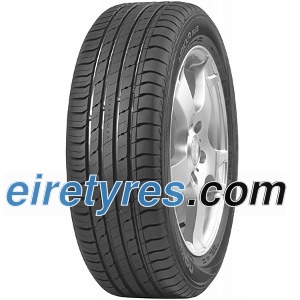

Note: Prices apply to tires without rim. Depending on the tire dimension, the tread pattern may vary.

Nokian
Hakka Blue
205/60 R15 95V XL
Tyre size
205/60 R15 95V XL
Change
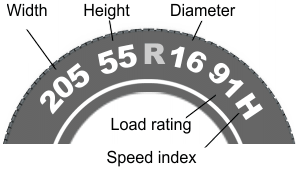
Identify the size of your tyre
The exact dimensions of a tyre can be found on the sidewall printed mark. The graphic shows how to read properties and dimensions of the tyre:
Stock Level
at the moment, this product is not in stock
Type of Tyre
Summer tyres
Speed Index
V
:
Approved up to
240 mph
EAN
6419440282725
Item No.
R-228754
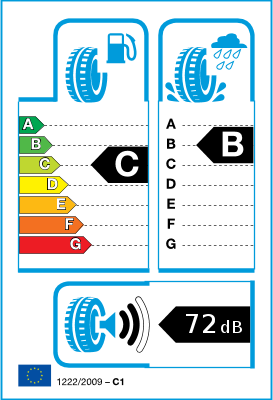
EU Tyre Label
Delticom efficiency index
The efficiency class label evaluated based on customer preferences.
Delticom centralized survey results from more than 40.000 customers from 15 European countries and created this index.
3.87 |
- Manufacturer description
- Tire Label
- General Product Safety (GPSR)
The high-performance Nokian Hakka Blue summer tyre can masterfully handle the rapidly changing road conditions in the summer.
Tailor-made for the northern roads, the newest member of the Hakka summer tyre range offers the best possible traction and precise handling for challenging wet roads, when drivers most often need a reliable partner.
The new innovations, the Dry Touch Sipe and Swoop Grooves, give Nokian Hakka Blue excellent grip and allow it to stop nearly a metre shorter than traditional summer tyres from a speed of 80 km/h (50 mph) on a rain-soaked road.
This new tyre, designed especially for high-powered cars and with a good, accurate driving feel, offers uncompromisingly safe and comfortable travel from the first moments of spring until long into the autumn.
The eco-friendliness of this sporty tyre also adds to your peace of mind. Many innovations launched together with Nokian Hakka Green, the baby brother of the Hakka Blue, ensure that the novelty is green by nature and moves smoothly. Very low rolling resistance results in fuel consumption among the lowest in its class.
New innovations maximise wet grip
According to research, rain is the weather phenomenon causing the most traffic accidents. Driving is easy on a sun-scorched highway, but when a sudden rain shower strikes, the possibility of temporarily losing control grows. A key factor is the loss of tyre grip or dangerous aquaplaning, which can quickly turn the driver into a passenger.
When optimising the road contact and developing the structure of Nokian Hakka Blue, we aimed at maximising wet grip. We utilised a high-speed camera for this purpose to a great extent.
The finishing touch on the exceptional wet grip and anti-aquaplaning characteristics are the new innovations that effectively remove water from between the tyre and the road or store it temporarily, as well as the tread compound adapted for the varying conditions in the north, says Development Manager Juha Pirhonen from Nokian Tyres.
The new Dry Touch Suction Sipe effectively sucks the water out from between the tyre and the road, routing it to the main grooves of the tyre. This allows the Hakka Blue to achieve maximum contact on a rain-beaten road and establish a firm grip on the road surface.
The sipe shape ensures that the firm tyre has excellent wet grip, even when worn. The unique Dry Touch Sipe is larger at the bottom, which means that as the tyre wears, the groove volume does not decrease but rather increases.
To prevent aquaplaning, separate Swoop Grooves were shaped in the transversal main grooves on the inner shoulder. These elliptical slots store more water, as the volume of the transversal grooves increases.
The transversal grooves are also cut to be more open, which accelerates the flow of exhaust water as the tyre pushes its way through a water layer. The flow of the water displaced by the surface tread is also accelerated by the four wide and polished main grooves. Polishing the grooves also improves the stylish appearance of the tyre.
According to the comparison tests performed by Nokian Tyres, the Nokian Hakka Blue has a braking distance of 39.5 metres (129.6 feet) from a speed of 80 km/h (50 mph). This is up to 0.8 metres (2.6 ft) less than traditional summer tyres.
Eco-friendly, comfortable ride
The new tread compound, a combination of silica and pine oil, is matched for higher speeds. The carefully selected combination also improves wet grip at very low temperatures, on those early spring mornings and as the autumn gets darker.
Pine oil added to the compound lowers the temperature of Hakka Blue by reducing the friction caused by molecular movement. This makes the Hakka Blue an excellent choice for varying summer weather. The end results are lower heat generation and rolling resistance.
EU Tyre Label and Efficiency Classes
The Tire Labeling Ordinance specifies the information requirements on fuel efficiency, wet grip and external rolling noise from tires. In addition, reference is made to the winter properties of the product.
The EU 1222/2009 regulation that has been in force since November 1st, 2012 has been revised and will be replaced by regulation EU 2020/740 from May 1st, 2021; From this point on, new requirements apply. The rating classes for fuel efficiency, wet grip and exterior noise have been changed and the layout of the EU label has been adjusted. The manufacturer's product data sheets stored in the EU database can be downloaded via a QR code integrated into the label. Information on snow grip and ice grip is also newly included for tires that meet these criteria.
The following tires are exempt from the regulation: - tires that are designed exclusively for installation on vehicles that were first registered before October 1, 1990 - retreaded tires (until a corresponding extension of EU VO 2020/740 has taken place) - professional off - Road tires - Racing tires - Tires with additional devices to improve traction, eg studded tires - T-type emergency tires - Tires with a permissible speed below 80 km/h - Tires for rims with a nominal diameter ≤ 254 mm or ≥ 635 mm
The criteria and evaluation classes at a glance

fuel efficiency
The fuel consumption depends on the rolling resistance of the tyres, the vehicle itself, the driving conditions and the driving style of the driver. The measured rolling resistance (rolling resistance coefficient) of the tire is divided into classes A (highest efficiency) to E (lowest efficiency).
If a vehicle is completely equipped with class A tires, a consumption reduction of up to 7.5%* is possible compared to class E tyres. In the case of commercial vehicles, it can even be higher.
(Source: European Commission Impact Assessment
* when measured according to the test methods set out in Regulation (EU) 2020/740)
Please note:
Fuel consumption depends to a large extent on your own driving style and can be significantly reduced by driving in an environmentally friendly manner. Tire pressure should be checked regularly to improve fuel efficiency.

wet grip
Wet grip is divided into classes A (shortest braking distance) - E (longest braking distance).
If a car is equipped with class A tires, compared to class E tires, a braking distance of up to 18 m can be reduced when braking from 80 km/h (on a road surface with average grip).*
*Source: wdk Economic Association of the German Rubber Industry eV
Please note:
Traffic safety depends to a large extent on your own driving style. The stopping distances must always be observed. Tire pressure should be checked regularly to improve wet grip.

External rolling noise
The noise emitted by a tire affects the overall volume of the vehicle and affects not only your own driving comfort, but also the noise pollution of the environment. In the EU tire label, the external rolling noise is divided into 3 classes from A (lowest rolling noise) - C (highest rolling noise), measured in decibels (dB) and compared with the European noise emission limit values for external tire rolling noise.
A
The pictogram with the classification "A" indicates that the tire's external rolling noise is more than 3 dB below the EU limit value in force until 2016.
B
The "B" classification means that the tyre's external rolling noise is up to 3 dB below or equal to the EU limit value in force until 2016.
C
The classification "C" indicates that the specified limit value is exceeded.
Nokian Tyres plc
Pirkkalaistie 7, P.O.Box 20, FI-37101, Nokia, Finnland
*Prices include VAT and delivery within Ireland.
**More than 90% of our orders reach the customer in the specified delivery time.