%service-partner-advantages-list%
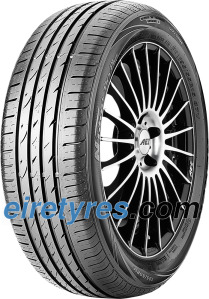
Nexen N blue HD Plus 185/60 R15 84T 4PR
Nexen
N blue HD Plus
185/60 R15 84T 4PR
Nexen - Korean tyre manufacturer
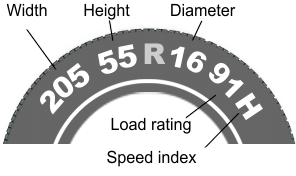
2. Ratio of tire height to tire width in%
3. Tire design: 'R' = radial tires (widely used), 'D' or '-' = diagonal tires (rare)
4. Required rim diameter for this tire in inches
5. Key figure for tire load capacity
6. Key figure for the permissible maximum speed (speed index)
7. Motorcycle tire identification, tires only approved for motorcycles
8. DOT labeling
9. Date of manufacture of the tire (week of production / year of production)
PR is an abbreviation of "ply rating". This label originally indicated the number of layers of cotton fishing line in the shell. A large number of bearings means a higher load capacity. When stronger materials were introduced for bearings, this term was removed from the actual number of bearings. Currently, a tire with 8 PR can only have four nylon linear bearings. Today, the stability of a controlled tire is expressed in terms of load capacity and speed capacity, and not in terms of the ply rating.
The efficiency class label evaluated based on customer preferences.
Delticom centralized survey results from more than 40.000 customers from 15 European countries and created this index.
3.35 |
- Manufacturer description
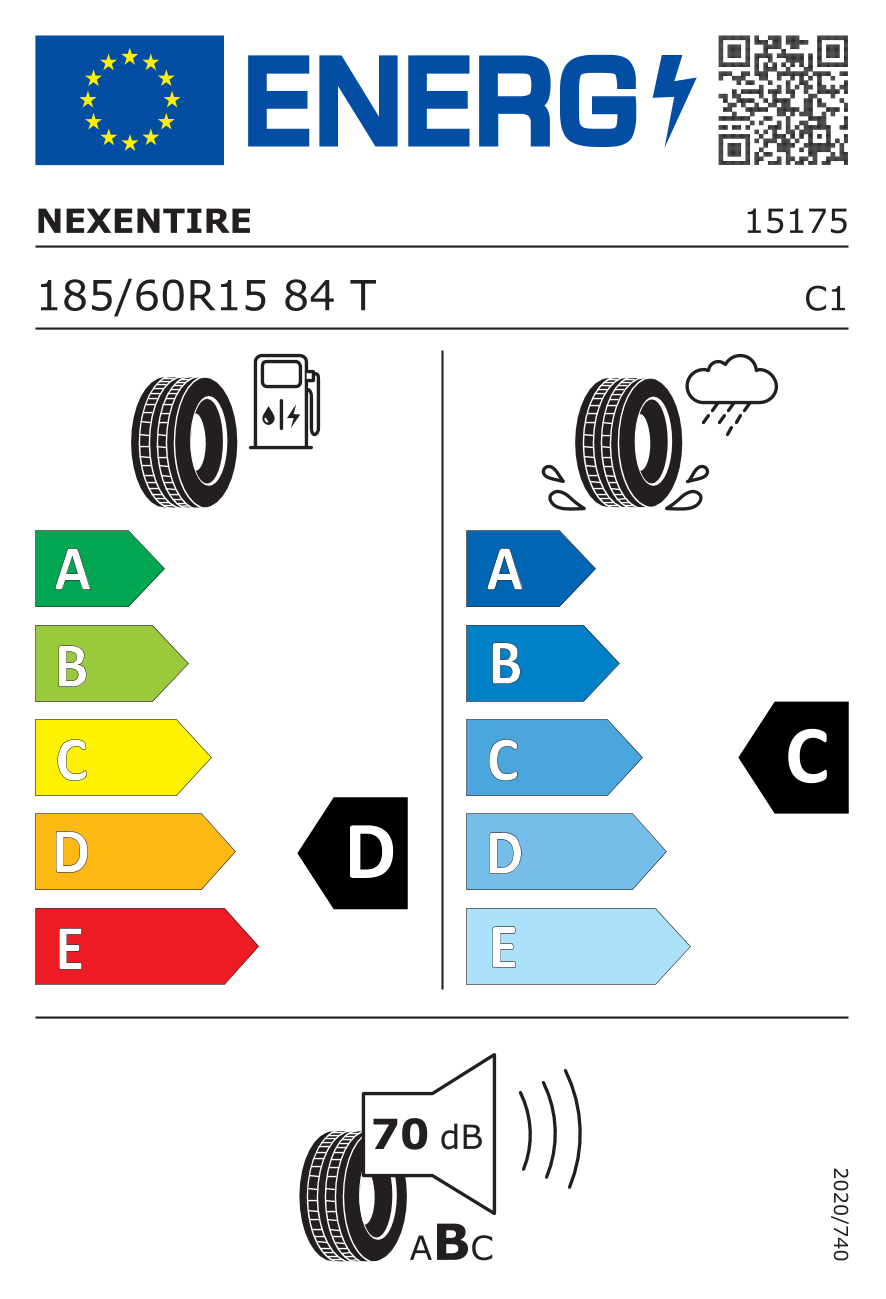
- Tire Label
- General Product Safety (GPSR)
Get Closer to Nature More Safely on N'blue HD Plus
Do you have your own way of releasing stress? Some people go up a mountain and shout while others listen to music or confide in their friends. You may want to go on a drive to ease your stress if you are a Nexen Tire fan. A drive for its own sake when you are down or just feeling gloomy will put you in a much better mood. To better help you with your drive for a change of mood or a release of stress, Nexen Tire has launched a new, exciting product: N’blue HD Plus, an upgraded version of N’blue HD with better performance and improved features that are the product of extensive investment in R&D.
Key Performance
Utmost Handling Performance
Efficient water drainage: Computer simulated four circumferential grooves and slightly curved lateral grooves effectively evacuate water and resist hydroplaning.
Outstanding straight driving stability: Continuous 3 center ribs help directional driving stability at a high speed.
Maximized Wet Performance
Jointless Bead Wire & High Hardness Bead Filler: Improve high speed stability and deliver better handling and steering response.
Maximized Wet Grip Compound: By applying the latest silica & advanced materials compounding technology, Maximized wet grip and higher fuel efficiency are secured at same time.
Reduced Rolling Resistance
High performance cornering: Solid shoulder rib facilitates precise cornering and keeps in tune with every corner by distributing forces.
Excellent driving stability in wet roads: Lateral grooves achieved by effective drainage enhance driving stability in wet roads.
Optimized Best Contour System (OBCS)
High Tensile Steel Belts: Enhance braking function with optimized grip pressure and stress dispersion by OBCS technology.
Optimized Carcass Contour System (OCCS)
High Modulus Carcass: Minimizes tire deformation and helps maintain the tire's shape to enhance driving stability with OCCS technology.
Put differently, based on the EU Labeling standard for easier comparison, the tire has better wet grip, rolling resistance and noise performance. With improved stability on wet roads, the N’blue HD Plus received many ‘A’s in wet braking, the highest level under the EU Labeling standard.Its wet grip, one aspect of a tire highly regarded in Europe, has also been improved, as 18 out of its 44 categories previously rated B received A. In addition, 16 categories in rolling resistance and 15 categories in noise were rated higher, allowing the tire to provide a higher level of silence and better ride. Its fuel efficiency is higher now, with 5 percent more mileage compared to its predecessor. Nexen Tire is committed to delivering higher quality and performance to customers through continued improvement and sustained investment in R&D.
EU Tyre Label and Efficiency Classes
The Tire Labeling Ordinance specifies the information requirements on fuel efficiency, wet grip and external rolling noise from tires. In addition, reference is made to the winter properties of the product.
The EU 1222/2009 regulation that has been in force since November 1st, 2012 has been revised and will be replaced by regulation EU 2020/740 from May 1st, 2021; From this point on, new requirements apply. The rating classes for fuel efficiency, wet grip and exterior noise have been changed and the layout of the EU label has been adjusted. The manufacturer's product data sheets stored in the EU database can be downloaded via a QR code integrated into the label. Information on snow grip and ice grip is also newly included for tires that meet these criteria.
The following tires are exempt from the regulation: - tires that are designed exclusively for installation on vehicles that were first registered before October 1, 1990 - retreaded tires (until a corresponding extension of EU VO 2020/740 has taken place) - professional off - Road tires - Racing tires - Tires with additional devices to improve traction, eg studded tires - T-type emergency tires - Tires with a permissible speed below 80 km/h - Tires for rims with a nominal diameter ≤ 254 mm or ≥ 635 mm
The criteria and evaluation classes at a glance
fuel efficiency
The fuel consumption depends on the rolling resistance of the tyres, the vehicle itself, the driving conditions and the driving style of the driver. The measured rolling resistance (rolling resistance coefficient) of the tire is divided into classes A (highest efficiency) to E (lowest efficiency).
If a vehicle is completely equipped with class A tires, a consumption reduction of up to 7.5%* is possible compared to class E tyres. In the case of commercial vehicles, it can even be higher.
(Source: European Commission Impact Assessment
* when measured according to the test methods set out in Regulation (EU) 2020/740)
Please note:
Fuel consumption depends to a large extent on your own driving style and can be significantly reduced by driving in an environmentally friendly manner. Tire pressure should be checked regularly to improve fuel efficiency.
wet grip
Wet grip is divided into classes A (shortest braking distance) - E (longest braking distance).
If a car is equipped with class A tires, compared to class E tires, a braking distance of up to 18 m can be reduced when braking from 80 km/h (on a road surface with average grip).*
*Source: wdk Economic Association of the German Rubber Industry eV
Please note:
Traffic safety depends to a large extent on your own driving style. The stopping distances must always be observed. Tire pressure should be checked regularly to improve wet grip.
External rolling noise
The noise emitted by a tire affects the overall volume of the vehicle and affects not only your own driving comfort, but also the noise pollution of the environment. In the EU tire label, the external rolling noise is divided into 3 classes from A (lowest rolling noise) - C (highest rolling noise), measured in decibels (dB) and compared with the European noise emission limit values for external tire rolling noise.
A
The pictogram with the classification "A" indicates that the tire's external rolling noise is more than 3 dB below the EU limit value in force until 2016.
B
The "B" classification means that the tyre's external rolling noise is up to 3 dB below or equal to the EU limit value in force until 2016.
C
The classification "C" indicates that the specified limit value is exceeded.
NEXEN TIRE EUROPE s.r.o.
Lise-Meitner-Strasse 1, 65779, Kelkheim, Germany