





%service-partner-advantages-list%
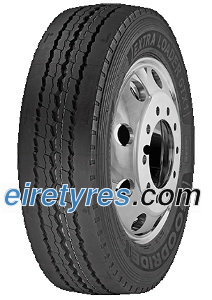
Matador DR2 Variant 205/75 R17.5 124/122M 14PR
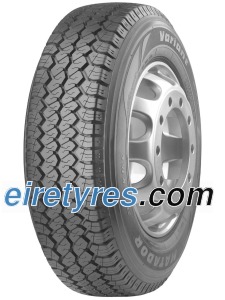
Matador
DR2 Variant
205/75 R17.5 124/122M 14PR
Matador - Tire made in Europe with German technology
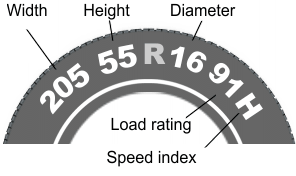
2. Ratio of tire height to tire width in%
3. Tire design: 'R' = radial tires (widely used), 'D' or '-' = diagonal tires (rare)
4. Required rim diameter for this tire in inches
5. Key figure for tire load capacity
6. Key figure for the permissible maximum speed (speed index)
7. Motorcycle tire identification, tires only approved for motorcycles
8. DOT labeling
9. Date of manufacture of the tire (week of production / year of production)
PR is an abbreviation of "ply rating". This label originally indicated the number of layers of cotton fishing line in the shell. A large number of bearings means a higher load capacity. When stronger materials were introduced for bearings, this term was removed from the actual number of bearings. Currently, a tire with 8 PR can only have four nylon linear bearings. Today, the stability of a controlled tire is expressed in terms of load capacity and speed capacity, and not in terms of the ply rating.
The efficiency class label evaluated based on customer preferences.
Delticom centralized survey results from more than 40.000 customers from 15 European countries and created this index.
3.18 |
- Manufacturer description
- Tire Label
- General Product Safety (GPSR)
• The tyre is constructed from an ALL STEEL construction with a no- tube rendering that consists of one load-bearing structure built from steelcord and three contact breaker insertions from the same type of material.
• The tyre base has a new profile: the applied hexagonal cord, double core, with steelcord protection and base fillings from special mixtures. The tyre body is constructed from a profiled inner rubber, with a new system of rubber covering of the steelcord body, and contact breakers with the application of a new shoulder part filling.
• The tread of the tyre is composed of two layers the external one which is made from a mixture that has a high durability even after a high number of made kilometers and an inner layer which leads away the heat produced during the rotation of a loaded tyre.
• Technical specification of the product and the tread pattern characteristics
this proven all-purpose tread pattern is designed for utility vehicles used for regional and local performance on A and Broads, and mountain region roads.
• These tread patterns are suitable for all-year performance and in all weather conditions. Because of their excellent driving qualities they are marked M+S. Mounting of the tyres with the DR 2 tread pattern is recommended for rear (traction) axle of the vehicle.
• During winter season it is possible to use these tyres for the whole vehicle, which is advantageous when using the front axle drive.
• The tyres with the DR 2 tread pattern have high durability and there is the possibility to re-create grooves.
Tread pattern characteristics
• Noticeable circumferential zigzag grooves provide, aside from the transfer of gripping power, also sufficient driving qualities - in particular on wet and snowy surfaces
• Sharp shoulder block edges provide excellent gripping qualities of the tread pattern in difficult operating conditions
• Configuration of lamellas considerably supports the adhesive qualities on wet and also dry surfaces
• Reinforcement of the shoulder block parts of the tread allows maintaining steady wearing out in varying load modes
Driving qualities
• The tread pattern of the tyre is suitable not only for all-season application but especially for winter season, because it provides excellent grip on snowy and icy surfaces.
EU Tyre Label and Efficiency Classes
The Tire Labeling Ordinance specifies the information requirements on fuel efficiency, wet grip and external rolling noise from tires. In addition, reference is made to the winter properties of the product.
The EU 1222/2009 regulation that has been in force since November 1st, 2012 has been revised and will be replaced by regulation EU 2020/740 from May 1st, 2021; From this point on, new requirements apply. The rating classes for fuel efficiency, wet grip and exterior noise have been changed and the layout of the EU label has been adjusted. The manufacturer's product data sheets stored in the EU database can be downloaded via a QR code integrated into the label. Information on snow grip and ice grip is also newly included for tires that meet these criteria.
The following tires are exempt from the regulation: - tires that are designed exclusively for installation on vehicles that were first registered before October 1, 1990 - retreaded tires (until a corresponding extension of EU VO 2020/740 has taken place) - professional off - Road tires - Racing tires - Tires with additional devices to improve traction, eg studded tires - T-type emergency tires - Tires with a permissible speed below 80 km/h - Tires for rims with a nominal diameter ≤ 254 mm or ≥ 635 mm
The criteria and evaluation classes at a glance
fuel efficiency
The fuel consumption depends on the rolling resistance of the tyres, the vehicle itself, the driving conditions and the driving style of the driver. The measured rolling resistance (rolling resistance coefficient) of the tire is divided into classes A (highest efficiency) to E (lowest efficiency).
If a vehicle is completely equipped with class A tires, a consumption reduction of up to 7.5%* is possible compared to class E tyres. In the case of commercial vehicles, it can even be higher.
(Source: European Commission Impact Assessment
* when measured according to the test methods set out in Regulation (EU) 2020/740)
Please note:
Fuel consumption depends to a large extent on your own driving style and can be significantly reduced by driving in an environmentally friendly manner. Tire pressure should be checked regularly to improve fuel efficiency.
wet grip
Wet grip is divided into classes A (shortest braking distance) - E (longest braking distance).
If a car is equipped with class A tires, compared to class E tires, a braking distance of up to 18 m can be reduced when braking from 80 km/h (on a road surface with average grip).*
*Source: wdk Economic Association of the German Rubber Industry eV
Please note:
Traffic safety depends to a large extent on your own driving style. The stopping distances must always be observed. Tire pressure should be checked regularly to improve wet grip.
External rolling noise
The noise emitted by a tire affects the overall volume of the vehicle and affects not only your own driving comfort, but also the noise pollution of the environment. In the EU tire label, the external rolling noise is divided into 3 classes from A (lowest rolling noise) - C (highest rolling noise), measured in decibels (dB) and compared with the European noise emission limit values for external tire rolling noise.
A
The pictogram with the classification "A" indicates that the tire's external rolling noise is more than 3 dB below the EU limit value in force until 2016.
B
The "B" classification means that the tyre's external rolling noise is up to 3 dB below or equal to the EU limit value in force until 2016.
C
The classification "C" indicates that the specified limit value is exceeded.
Continental Reifen Deutschland GmbH
Continental-Plaza 1, 30175, Hannover, Germany