









 %service-partner-advantages-list%
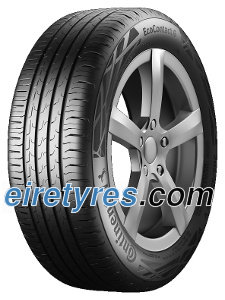
Continental EcoContact 5 215/55 R17 94V AO


Note: Prices apply to tires without rim. Depending on the tire dimension, the tread pattern may vary.

Continental
EcoContact 5
215/55 R17 94V AO
Tyre size
215/55 R17 94V AO
Change
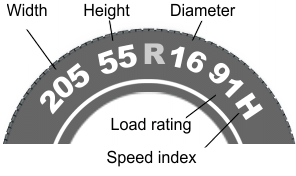
Identify the size of your tyre
The exact dimensions of a tyre can be found on the sidewall printed mark. The graphic shows how to read properties and dimensions of the tyre:
Stock Level
at the moment, this product is not in stock
Type of Tyre
Summer tyres
Speed Index
V
:
Approved up to
240 mph
EAN
4019238757453
Item No.
R-320324
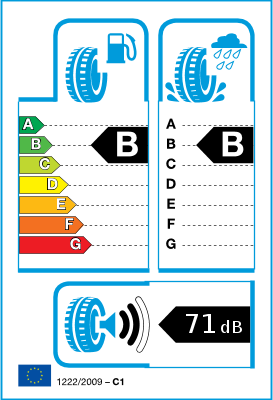
EU Tyre Label
Delticom efficiency index
The efficiency class label evaluated based on customer preferences.
Delticom centralized survey results from more than 40.000 customers from 15 European countries and created this index.
4.05 |
- Manufacturer description
- Tire Label
- General Product Safety (GPSR)
For the sake of safety and the environment
Developed for mid-sized and compact class vehicles. Perfect for safe, fuel efficient driving. Engineered in Germany, Continental offers premium tyres with optimum braking performance and safety. Optimised rolling resistance for reduced fuel consumption. Trusted by leading car manufacturers, including the models eg. Audi A3, BMW Series 3 and Peugeot 1007.
The new Performance-Eco tire
Combining short braking distances on wet and dry roads with low rolling resistance has in the past always been considered extremely problematic. Europe's leading tire manufacturer Continental has now launched a product which resolves this problem with apparent ease - the new ContiEcoContact™ 5. The tire engineers did, however, have to tread new ground in terms of all the tire elements involved - casing, compound, tire contour and tread pattern design - in order to achieve the high level of progress.
The main target conflicts when reducing rolling resistance relate to the safety-relevant characteristics of a tire. This means that the conflict between rolling resistance and handling can be influenced via the design, whilst the tire compound can assist in the problem area of low rolling resistance and short braking distances in the wet, changing the tire contour allows mileage performance to be enhanced, and the tread pattern can have a positive effect on braking characteristics in the wet. The sum total of the potential improvements helps the new tire to achieve a considerably better overall performance with even more balanced driving characteristics. The engineers at Continental therefore focused on all these areas in order to meet the high requirements made on the new tire for compact cars and large saloons.
Technical details
For the sake of safety and the environment. Optimised rolling resistance for reduced fuel consumption. The ContiEcoContact 5 was developed in close co-operation with Europe’s leading car manufacturers. This is an entirely new tire concept aimed specifically at motorists who drive longer distances, but also at those who are very mindful of both fuel consumption and the environment.
The challenge was to reduce rolling resistance on the tire and, at the same time, ensure a high level of safety during braking. This required a completely new approach to all four components of the tire: design, contour, compound and tread pattern. The result was reduced CO2 emissions and lower fuel consumption, while still delivering excellent braking performance. High braking safety and short braking distances on wet roads. The combination of special additives and optimised tread lug edges makes for improved grip in the wet, leading to short, safe braking distances on wet roads. Moreover, functionalised polymer chains firmly linked to the silica mean lower rolling resistance.
Extra-thin sipes reduce tread deformation, thereby also minimising energy loss. Best handling on wet and dry roads. A higher apex and the use of additional bead reinforcements ensure safer and more direct transmission of the lateral forces occurring when steering on wet and dry roads. The weight-reduced sidewall is more supple in its design, thereby also contributing towards improved rolling resistance. Less lost energy with good handling characteristics. Less deformation movement in the sidewall area above the rim and easier deflection in the sidewall flexing zone by constructive measures. A flat contour with optimal distribution of thread grooves stands for a reduced tread movement and a minimized lateral and longitudinal slip.
Benefits
- Optimised rolling resistance for reduced fuel consumption
- High braking safety and short braking distances on wet roads
- Best handling on wet and dry roads
Optimised rolling resistance for reduced fuel consumption. The ContiEcoContact™ 5 was developed in close co-operation with Europe’s leading car manufacturers. This is an entirely new tyre concept aimed specifically at motorists who drive longer distances, but also at those who are very mindful of both fuel consumption and the environment. The challenge was to reduce rolling resistance on the tyre and, at the same time, ensure a high level of safety during braking. This required a completely new approach to all four components of the tyre: design, contour, compound and tread pattern. The result was reduced CO2 emissions and lower fuel consumption, while still delivering excellent braking performance.
High braking safety and short braking distances on wet roads. The combination of special additives and optimised tread lug edges makes for improved grip in the wet, leading to short, safe braking distances on wet roads. Moreover, functionalised polymer chains firmly linked to the silica mean lower rolling resistance. Extra-thin sipes reduce tread deformation, thereby also minimising energy loss.
Best handling on wet and dry roads. A higher apex and the use of additional bead reinforcements ensure safer and more direct transmission of the lateral forces occurring when steering on wet and dry roads. The weight-reduced sidewall is more supple in its design, thereby also contributing towards improved rolling resistance.
EU Tyre Label and Efficiency Classes
The Tire Labeling Ordinance specifies the information requirements on fuel efficiency, wet grip and external rolling noise from tires. In addition, reference is made to the winter properties of the product.
The EU 1222/2009 regulation that has been in force since November 1st, 2012 has been revised and will be replaced by regulation EU 2020/740 from May 1st, 2021; From this point on, new requirements apply. The rating classes for fuel efficiency, wet grip and exterior noise have been changed and the layout of the EU label has been adjusted. The manufacturer's product data sheets stored in the EU database can be downloaded via a QR code integrated into the label. Information on snow grip and ice grip is also newly included for tires that meet these criteria.
The following tires are exempt from the regulation: - tires that are designed exclusively for installation on vehicles that were first registered before October 1, 1990 - retreaded tires (until a corresponding extension of EU VO 2020/740 has taken place) - professional off - Road tires - Racing tires - Tires with additional devices to improve traction, eg studded tires - T-type emergency tires - Tires with a permissible speed below 80 km/h - Tires for rims with a nominal diameter ≤ 254 mm or ≥ 635 mm
The criteria and evaluation classes at a glance

fuel efficiency
The fuel consumption depends on the rolling resistance of the tyres, the vehicle itself, the driving conditions and the driving style of the driver. The measured rolling resistance (rolling resistance coefficient) of the tire is divided into classes A (highest efficiency) to E (lowest efficiency).
If a vehicle is completely equipped with class A tires, a consumption reduction of up to 7.5%* is possible compared to class E tyres. In the case of commercial vehicles, it can even be higher.
(Source: European Commission Impact Assessment
* when measured according to the test methods set out in Regulation (EU) 2020/740)
Please note:
Fuel consumption depends to a large extent on your own driving style and can be significantly reduced by driving in an environmentally friendly manner. Tire pressure should be checked regularly to improve fuel efficiency.

wet grip
Wet grip is divided into classes A (shortest braking distance) - E (longest braking distance).
If a car is equipped with class A tires, compared to class E tires, a braking distance of up to 18 m can be reduced when braking from 80 km/h (on a road surface with average grip).*
*Source: wdk Economic Association of the German Rubber Industry eV
Please note:
Traffic safety depends to a large extent on your own driving style. The stopping distances must always be observed. Tire pressure should be checked regularly to improve wet grip.

External rolling noise
The noise emitted by a tire affects the overall volume of the vehicle and affects not only your own driving comfort, but also the noise pollution of the environment. In the EU tire label, the external rolling noise is divided into 3 classes from A (lowest rolling noise) - C (highest rolling noise), measured in decibels (dB) and compared with the European noise emission limit values for external tire rolling noise.
A
The pictogram with the classification "A" indicates that the tire's external rolling noise is more than 3 dB below the EU limit value in force until 2016.
B
The "B" classification means that the tyre's external rolling noise is up to 3 dB below or equal to the EU limit value in force until 2016.
C
The classification "C" indicates that the specified limit value is exceeded.
Continental Reifen Deutschland GmbH
Continental-Plaza 1, 30175, Hannover, Germany
*Prices include VAT and delivery within Ireland.
**More than 90% of our orders reach the customer in the specified delivery time.