The efficiency class label evaluated based on customer preferences. Delticom centralized survey results from more than 40.000 customers from 15 European countries and created this index.
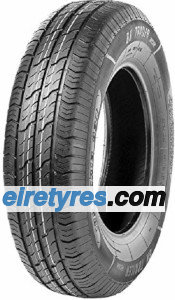
# BKT Trailer 202 – Durable Performance for Heavy-Duty Transport Built for reliability and long service life, the BKT Trailer 202 is engineered to meet the demands of modern trailer applications. This tire delivers consistent performance across a variety of road conditions, making it a trusted choice for commercial transport operators. ## Superior Tread Design and Stability Featuring an advanced tread pattern, the Trailer 202 ensures excellent road grip and even wear distribution. This enhances fuel efficiency and reduces downtime, supporting optimal fleet productivity. Its robust construction provides enhanced load-carrying capability and resistance to damage from road hazards. ## Ideal for Trailer Axles Commonly used on trailer axles, this tire supports high load indices and offers low rolling resistance, contributing to lower fuel consumption. The design promotes stable handling and reduced vibration, improving driver comfort and cargo safety over long distances. Whether you're managing regional deliveries or long-haul routes, the BKT Trailer 202 combines durability with performance, offering a cost-effective solution for demanding transport operations..
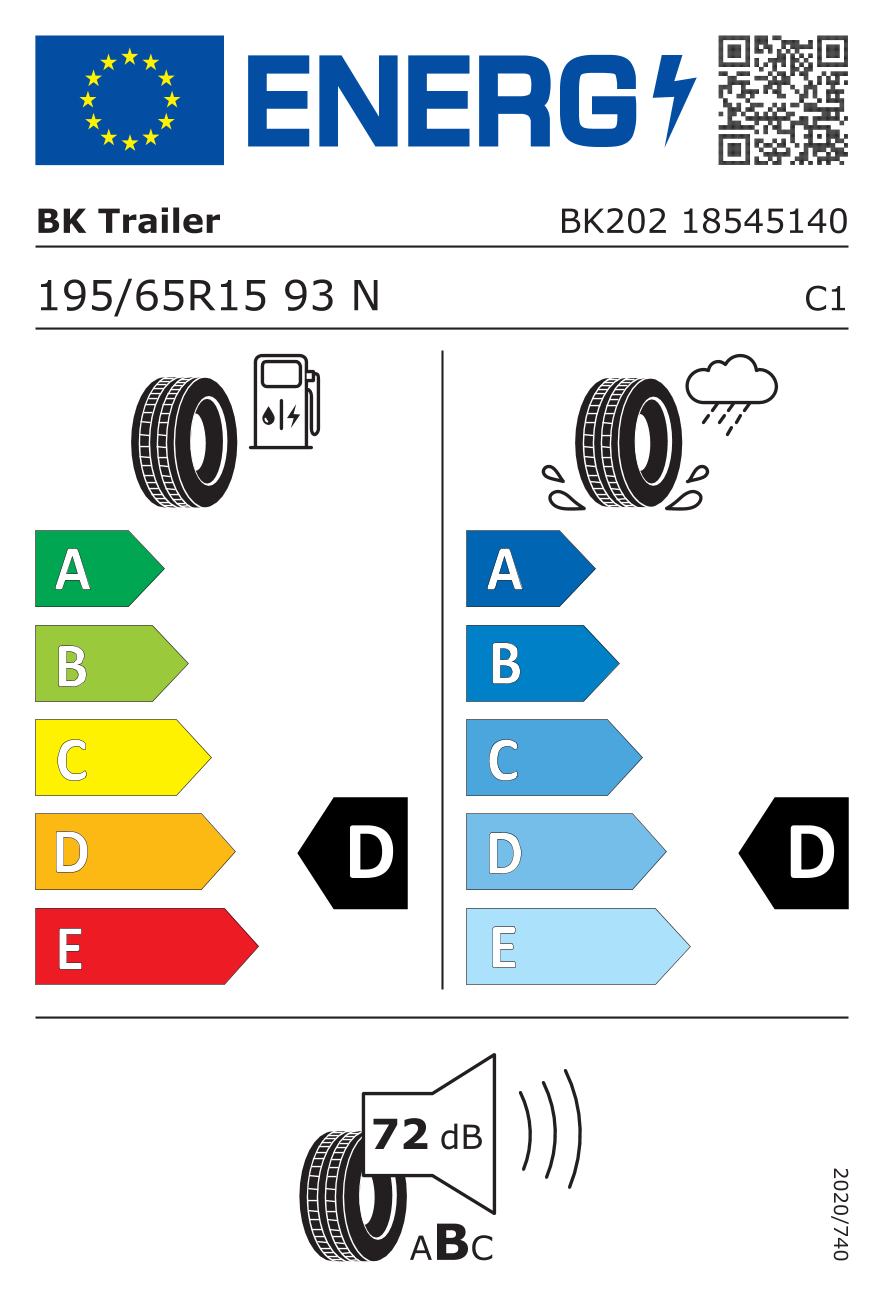
The Tire Labeling Ordinance specifies the information requirements on fuel efficiency, wet grip and external rolling noise from tires. In addition, reference is made to the winter properties of the product.
The EU 1222/2009 regulation that has been in force since November 1st, 2012 has been revised and will be replaced by regulation EU 2020/740 from May 1st, 2021; From this point on, new requirements apply. The rating classes for fuel efficiency, wet grip and exterior noise have been changed and the layout of the EU label has been adjusted. The manufacturer's product data sheets stored in the EU database can be downloaded via a QR code integrated into the label. Information on snow grip and ice grip is also newly included for tires that meet these criteria.
The following tires are exempt from the regulation: - tires that are designed exclusively for installation on vehicles that were first registered before October 1, 1990 - retreaded tires (until a corresponding extension of EU VO 2020/740 has taken place) - professional off - Road tires - Racing tires - Tires with additional devices to improve traction, eg studded tires - T-type emergency tires - Tires with a permissible speed below 80 km/h - Tires for rims with a nominal diameter ≤ 254 mm or ≥ 635 mm
The criteria and evaluation classes at a glance
fuel efficiency
The fuel consumption depends on the rolling resistance of the tyres, the vehicle itself, the driving conditions and the driving style of the driver. The measured rolling resistance (rolling resistance coefficient) of the tire is divided into classes A (highest efficiency) to E (lowest efficiency).
If a vehicle is completely equipped with class A tires, a consumption reduction of up to 7.5%* is possible compared to class E tyres. In the case of commercial vehicles, it can even be higher. (Source: European Commission Impact Assessment * when measured according to the test methods set out in Regulation (EU) 2020/740)
Please note: Fuel consumption depends to a large extent on your own driving style and can be significantly reduced by driving in an environmentally friendly manner. Tire pressure should be checked regularly to improve fuel efficiency.
wet grip
Wet grip is divided into classes A (shortest braking distance) - E (longest braking distance).
If a car is equipped with class A tires, compared to class E tires, a braking distance of up to 18 m can be reduced when braking from 80 km/h (on a road surface with average grip).* *Source: wdk Economic Association of the German Rubber Industry eV
Please note: Traffic safety depends to a large extent on your own driving style. The stopping distances must always be observed. Tire pressure should be checked regularly to improve wet grip.
External rolling noise
The noise emitted by a tire affects the overall volume of the vehicle and affects not only your own driving comfort, but also the noise pollution of the environment. In the EU tire label, the external rolling noise is divided into 3 classes from A (lowest rolling noise) - C (highest rolling noise), measured in decibels (dB) and compared with the European noise emission limit values for external tire rolling noise.
A The pictogram with the classification "A" indicates that the tire's external rolling noise is more than 3 dB below the EU limit value in force until 2016. B The "B" classification means that the tyre's external rolling noise is up to 3 dB below or equal to the EU limit value in force until 2016. C The classification "C" indicates that the specified limit value is exceeded.
Qingtao Li
Mailänder Strasse14, 60598, Frankfurt am Main, Germany









 %service-partner-advantages-list%