The efficiency class label evaluated based on customer preferences. Delticom centralized survey results from more than 40.000 customers from 15 European countries and created this index.
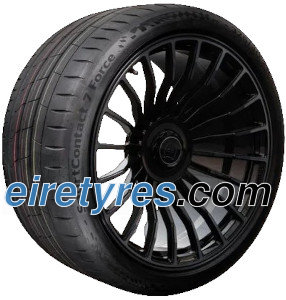
The SportContact 7 Force is built for drivers who expect more from every moment on the road. It’s a tire designed to turn power into confidence and movement into control. With a construction made for high-performance vehicles and a character shaped by the spirit of modern sports driving, it delivers pure driving pleasure. The SportContact 7 Force lets your car show what it’s truly capable of. With the stability, trust and dynamic feel that defines a new level of sportiness.
If precision matters to you, it should matter to your tire too. The SportContact 7 Force adapts instantly to every twist, turn and push of the road. Its intelligent footprint shifts toward the powerful outer shoulder, giving you razor-sharp steering and ultimate dry-grip confidence. Every move feels controlled. Every corner feels like yours. So take the lead. Your tire follows with absolute precision.
Power means nothing if your grip can’t keep up. That’s why the refined BlackChili compound delivers incredible traction whether you’re cruising the streets or chasing performance on the track. It works in perfect harmony with the tire’s stiff construction, giving you explosive dry-surface grip while maintaining reliable braking, wet performance and stability in every condition. Feel the confidence that only true grip can give you.
Your car isn’t ordinary. So why should your tire be? Every fitment of the SportContact 7 Force is tailor-built with its own construction and high-tech tuning to transfer pure power onto the road. For maximum grip, precision and speed, up to 360 km/h. How is this even possible? By applying innovative racing technologies that ensure precise force transmission in everyday driving. This way, your car delivers the sporty performance it was truly designed to give.
We make you ready for e-mobility. Our EV-compatible symbol confirms that the tire meets the requirements of electric vehicles as well as cars with combustion or hybrid engines.
The Tire Labeling Ordinance specifies the information requirements on fuel efficiency, wet grip and external rolling noise from tires. In addition, reference is made to the winter properties of the product.
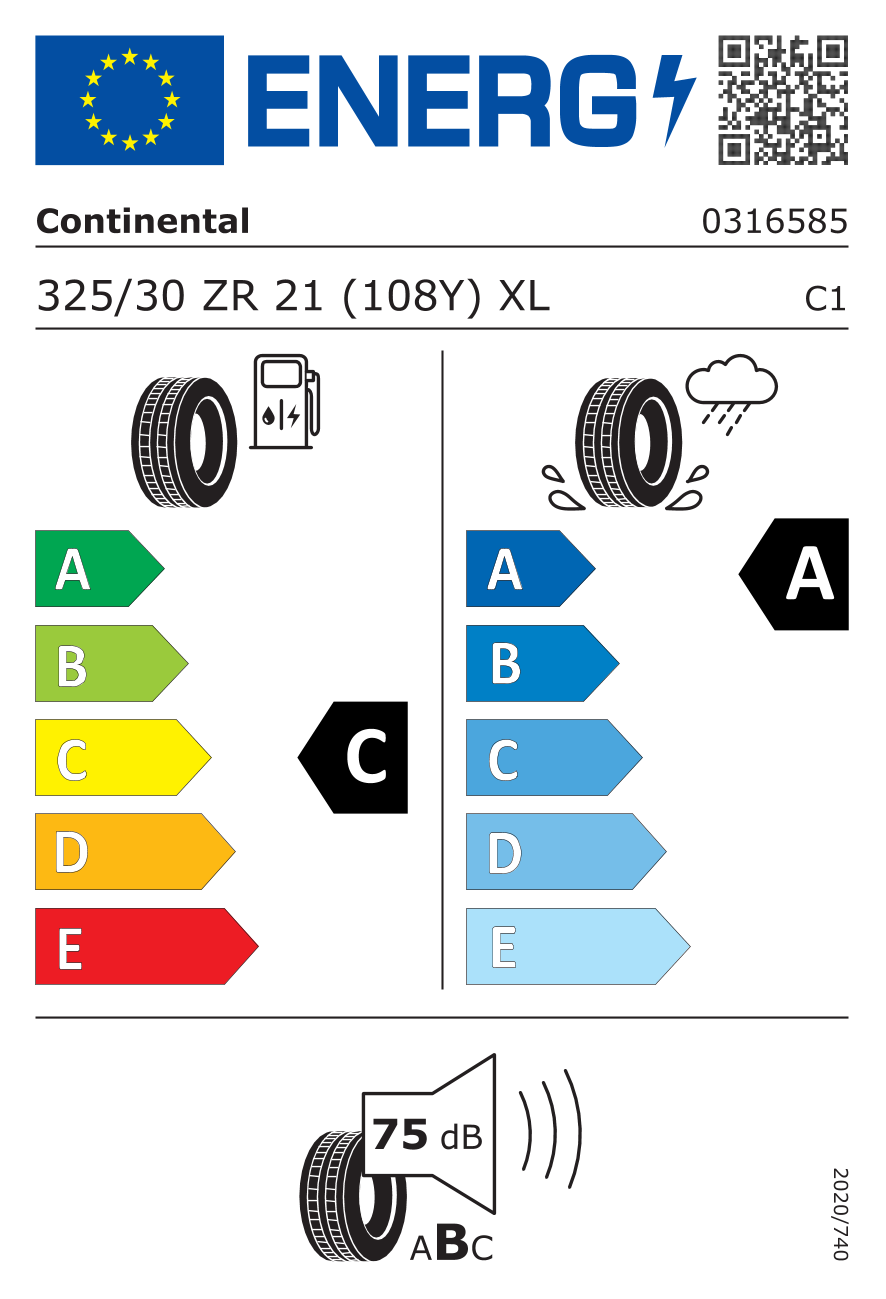
The EU 1222/2009 regulation that has been in force since November 1st, 2012 has been revised and will be replaced by regulation EU 2020/740 from May 1st, 2021; From this point on, new requirements apply. The rating classes for fuel efficiency, wet grip and exterior noise have been changed and the layout of the EU label has been adjusted. The manufacturer's product data sheets stored in the EU database can be downloaded via a QR code integrated into the label. Information on snow grip and ice grip is also newly included for tires that meet these criteria.
The following tires are exempt from the regulation: - tires that are designed exclusively for installation on vehicles that were first registered before October 1, 1990 - retreaded tires (until a corresponding extension of EU VO 2020/740 has taken place) - professional off - Road tires - Racing tires - Tires with additional devices to improve traction, eg studded tires - T-type emergency tires - Tires with a permissible speed below 80 km/h - Tires for rims with a nominal diameter ≤ 254 mm or ≥ 635 mm
The criteria and evaluation classes at a glance
fuel efficiency
The fuel consumption depends on the rolling resistance of the tyres, the vehicle itself, the driving conditions and the driving style of the driver. The measured rolling resistance (rolling resistance coefficient) of the tire is divided into classes A (highest efficiency) to E (lowest efficiency).
If a vehicle is completely equipped with class A tires, a consumption reduction of up to 7.5%* is possible compared to class E tyres. In the case of commercial vehicles, it can even be higher. (Source: European Commission Impact Assessment * when measured according to the test methods set out in Regulation (EU) 2020/740)
Please note: Fuel consumption depends to a large extent on your own driving style and can be significantly reduced by driving in an environmentally friendly manner. Tire pressure should be checked regularly to improve fuel efficiency.
wet grip
Wet grip is divided into classes A (shortest braking distance) - E (longest braking distance).
If a car is equipped with class A tires, compared to class E tires, a braking distance of up to 18 m can be reduced when braking from 80 km/h (on a road surface with average grip).* *Source: wdk Economic Association of the German Rubber Industry eV
Please note: Traffic safety depends to a large extent on your own driving style. The stopping distances must always be observed. Tire pressure should be checked regularly to improve wet grip.
External rolling noise
The noise emitted by a tire affects the overall volume of the vehicle and affects not only your own driving comfort, but also the noise pollution of the environment. In the EU tire label, the external rolling noise is divided into 3 classes from A (lowest rolling noise) - C (highest rolling noise), measured in decibels (dB) and compared with the European noise emission limit values for external tire rolling noise.
A The pictogram with the classification "A" indicates that the tire's external rolling noise is more than 3 dB below the EU limit value in force until 2016. B The "B" classification means that the tyre's external rolling noise is up to 3 dB below or equal to the EU limit value in force until 2016. C The classification "C" indicates that the specified limit value is exceeded.






 %service-partner-advantages-list%